
Estilo de vida
El arte de viajar en solitario cuando estás abierto a conocer a alguien
Viajar solo te transforma. Y, cuando se vive con una apertura genuina, también te pone en el camino de personas que podrían transformarte aún más.
There is a version of solo travel that most accomplished people have already experienced: the business trip that extends into a weekend, the solo holiday taken partly for efficiency and partly to escape, the conference that leaves you in an interesting city for three days with no particular plan for the evenings. You know the texture of it. The hotel room that is too quiet. The excellent restaurant where you eat alone at the bar, half-reading something on your phone, half-watching the room.
And then, occasionally, something else happens. A conversation that should not have started, but did. An evening that was supposed to be solitary, and became something else. A connection that arrived without any particular effort or intention, precisely because you were somewhere you did not usually go, without the social architecture that normally determines how you spend your time.
These moments are not accidental. They are the predictable result of a specific set of conditions: a person alone in an unfamiliar environment, without the usual structures that regulate social exposure, open — if only by circumstance — to encounters that do not fit the normal categories. Understanding what produces them, and how to cultivate them more deliberately, is the actual subject of this piece.
Why Alone Changes Everything
The social dynamics of solo travel are fundamentally different from those of traveling with others. When you travel with a companion — a friend, a colleague, a family member — you are in a closed social circuit. The conversation is internal, the attention directed inward, and the signals you emit to the surrounding environment are those of a person who is already accompanied and therefore, in the social shorthand that most people read automatically, not available.
Alone, you are open by default. You make eye contact differently. You inhabit space differently — the way you sit at a bar, the way you pause in a museum, the way you linger over a menu. These are not conscious choices; they are the natural posture of someone who has not yet determined how the evening will unfold. And other people, consciously or not, read them as invitations.
This is the first and most important thing to understand about traveling solo with openness: you do not have to do much. The conditions do most of the work. What you have to do is not interfere with them — by filling every available moment with your phone, by retreating into familiar podcasts and playlists, by moving so efficiently through a place that there is no time for anything unplanned to happen.
“The best encounters of a solo trip tend to happen in the space between plans — in the hour that was not scheduled, at the restaurant where you asked to sit at the bar instead of a table for one.”
Choosing Environments That Reward Presence
Not all travel environments are equally conducive to genuine encounter. The airport lounge, for all its comfort, is a place where everyone is emphatically in transit and nobody wants to be disturbed. The guided tour creates a particular social dynamic that is excellent for making acquaintances and poor for anything deeper. The resort pool is fine for many things and rarely the setting for the kind of conversation that stays with you.
The environments that tend to produce the most interesting encounters share certain features: they are intimate in scale, they have a natural reason for people to interact, and they attract a self-selecting group of people who are comfortable with their own company. A small restaurant with a bar where solo diners are genuinely welcomed. A wine tasting hosted by the vineyard itself. A cooking class, a private gallery event, a concert in a venue small enough that the audience has a collective character. These are the places where the person next to you is there because they chose to be there, in the same specific way that you chose to be there, and that shared specificity is already a beginning.
The Hotel as Social Infrastructure
The hotel you choose matters more than most travelers realize, particularly for solo travel with social intention. A large international chain in the business district is efficient and entirely anonymous. A smaller hotel with a genuine design sensibility, a bar that draws locals as well as guests, and common spaces that encourage lingering is something entirely different: it is a ready-made social environment in which you already belong, and in which the bar stool next to you is occupied by someone who made the same specific choice about where to stay.
The rise of boutique hotels and the luxury hotel’s investment in public spaces is not incidental to this. The Ace Hotel figured this out early. Soho House built an entire business model around it. The idea that a hotel’s social spaces could be as important as its rooms reflects an accurate understanding of what solo travelers — particularly accomplished ones — actually need when they are somewhere new.
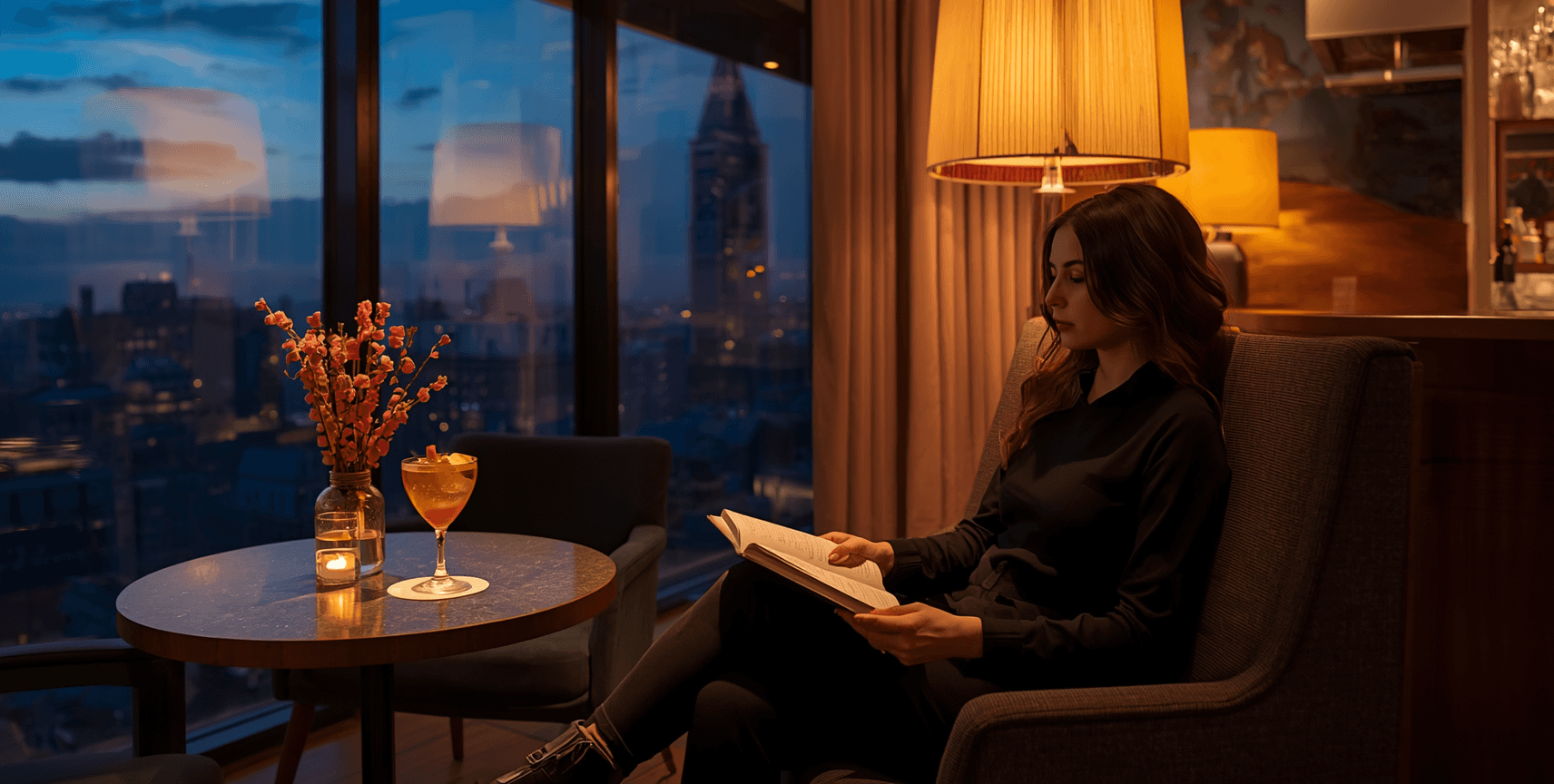
Arriving at the bar at a reasonable hour, with nothing more than a book you may or may not read, is one of the highest-yield activities available to a solo traveler who is genuinely open to encounter. It requires very little. It produces, with notable regularity, something worth having.
“The right hotel bar is not a place to drink alone. It is a place to be alone in public — which is an entirely different thing, and considerably more interesting.”
Openness as a Practiced State
The quality of openness that makes solo travel productive for connection is not simply a mood or an attitude. It is a practiced state that requires some active maintenance, particularly for people who have spent years in high-performance professional environments where efficiency and focus are the default orientations.
Openness, in this context, means a willingness to let the unplanned happen without immediately redirecting toward something scheduled. It means being genuinely curious about the person sitting next to you, not as a potential contact or a possible asset, but as someone whose life is interesting in ways you do not yet know. It means resisting the professional reflex to assess the value of an interaction before allowing it to develop.
It also means accepting a certain amount of nothing. Not every evening will produce an interesting encounter. Not every conversation will go anywhere. The openness that makes the good ones possible requires a tolerance for the unremarkable ones, which is something that people accustomed to optimizing their time sometimes find difficult to maintain.
What to Do With What You Find
The encounters that solo travel produces tend to have a particular texture: intensity without context, connection without continuity. Two people who meet in Barcelona or Lisbon or Kyoto have a quality of mutual attention that is rarely possible in their ordinary lives, precisely because they are both temporarily free of the structures that normally organize their time and attention. This can produce something real. It can also produce something that is only real in the specific conditions of that time and place.
The distinction is worth making early, and honestly. Some of what happens in the liminal space of solo travel is genuinely significant — the beginning of something that survives contact with ordinary life and grows into something more. Some of it is the specific product of the conditions: meaningful in the moment, and rightly so, but not necessarily the beginning of anything further.
The person who approaches solo travel with genuine openness — rather than with the specific goal of finding a romantic partner, which tends to produce a particular kind of effortful attention that people can sense and find slightly uncomfortable — is more likely to encounter both kinds, and to be able to distinguish between them clearly enough to know which deserves more investment.
The art of traveling solo with openness is, ultimately, the art of being genuinely present in a place and in the encounters it produces. It requires attention without agenda, curiosity without calculation, and the willingness to allow something unexpected to happen without immediately deciding what it means. These are, it turns out, some of the same qualities that make a person genuinely interesting to encounter. Which is, in itself, a fairly efficient starting position.
Join the Amari Club Waitlist
Amari Club connects exceptional men with extraordinary partners.
Apply for early access to our private membership network.
Join the waitlist at amariclub.com