Amari Insights
CDMX: The Gentrification of Romance
How CDMX’s Rise Is Changing Who Lives There — and Who They Meet
The Gentrification of Romance: How CDMX’s Rise Is Changing Who Lives There — and Who They Meet
Every city that becomes a destination changes in the process of becoming one. The forces that produce cultural and social richness — the arrival of creative and professional talent from elsewhere, the investment in restaurants and cultural institutions, the gradual elevation of what is available and what is expected — are the same forces that eventually price out the people who made the city interesting in the first place, and replace genuine vitality with its more expensive imitation.
Mexico City is in the middle of this process, not at its end. The neighborhoods of Roma Norte, Condesa, and Polanco have been transformed over the past fifteen years in ways that have produced genuine gains in quality of life, cultural richness, and international accessibility — and genuine losses in affordability, local character, and the specific texture of the social world that preceded the transformation. Both things are true simultaneously, and an honest account of what the city offers right now requires acknowledging both.
For the accomplished single who is considering Mexico City as a social and romantic destination, understanding these dynamics is not merely academic. The forces shaping the city’s social fabric are shaping, directly, who is available to meet, in what contexts, and with what quality of encounter.
Three Social Worlds, One City
Mexico City’s current social landscape in its most desirable neighborhoods is best understood as the coexistence of three distinct social worlds that interact with each other in ways that are sometimes fluid and sometimes sharply bounded.
The first is the established local professional and cultural class: Mexico City families with deep roots in the city, professional networks that go back generations, a relationship with the neighborhood that predates the current wave of international attention. This world has its own institutions, its own social rhythms, and its own standards. It is not closed to outsiders, but it is navigated on its own terms, and entry tends to be mediated by introduction and by demonstrated genuine engagement with the city and its culture.
The second is the international arrival class: the founders, investors, creative professionals, and mobile executives described in the previous article, who have chosen Mexico City as a base for reasons that range from the economic to the cultural to the personal. This world is more easily accessible to newcomers — it is, in some sense, constituted by newcomers — and its social infrastructure is organized around the needs of people who are in the process of building networks from scratch.
The third is the gentrification class proper: the tourists who have become semi-permanent residents, the remote workers who arrived for a month and stayed for six, the people whose relationship with the city is mediated primarily by its surface qualities — the aesthetics, the price differential, the novelty — rather than by genuine engagement with its culture and people.
“Mexico City in 2026 contains three overlapping social worlds. Which one you inhabit — and whether you manage to move between them — determines most of what your social and romantic life in the city will actually look like.”
The Impact on Social Texture
The presence of all three worlds simultaneously in the same neighborhoods produces a social texture that is, in the most interesting respects, genuinely rich. The proximity of the local professional class to the international arrivals creates the conditions for cross-cultural encounter at a level of sophistication that is rare. The events and social spaces that serve both communities tend to attract a genuinely interesting mix of people.
It also produces, less happily, a social stratification that is easy to misread. The neighborhood of Roma Norte, observed from the outside — from the perspective of a new arrival looking for social entry points — can appear more homogeneous and more accessible than it is. The coffee shops and restaurants that populate its streets serve all three social worlds, sometimes simultaneously, and the social distinctions between them are not visible to anyone who does not already know where to look.
The practical consequence of this is that the quality of social encounter in Mexico City is more dependent than it might initially appear on the quality of your social strategy — on whether you are approaching the city with genuine intention and a willingness to invest in the right relationships, or whether you are moving through it at the surface level that produces surface-level connections.
The Tension at the Heart of the City
The most honest account of Mexico City’s current moment has to acknowledge a tension that the city’s promoters tend to understate and its critics tend to overstate. The transformation of Roma Norte and Condesa has produced a genuinely better physical city in many respects: more beautiful restaurants, more well-maintained public spaces, a higher general standard of what is available and what is possible. It has also produced a social world that is, in the neighborhoods most affected, less rooted and less locally specific than it was.
The street that used to house a decades-old family business and a neighborhood gathering point now houses a natural wine bar that serves a clientele that did not exist five years ago. The apartment that used to rent to a Mexico City family now rents to a rotating cast of remote workers on three-month stays. These changes are neither entirely good nor entirely bad, but they do change the social texture of the neighborhood in ways that matter for the quality of the connections it produces.
The people who navigate this tension most successfully tend to be the ones who invest in the local dimension of the city rather than only in its international dimension. Who develop relationships with the Mexico City-born residents of their neighborhood, who learn the history of the street they live on, who participate in the social institutions — the Sunday market, the neighborhood cultural events, the restaurants that predate the wave — that give the city its character and connect them to the people whose city it actually is.
“Mexico City rewards genuine investment in a way that most cities do not. The distinction between the visitor and the participant is clear to the people who live there, and they respond to each very differently.”
What the Best Encounters Have in Common
The accounts that people give of the most meaningful social and romantic encounters they have had in Mexico City — the connections that turned into genuine friendships, significant relationships, lasting partnerships — share a common structure that is worth examining.
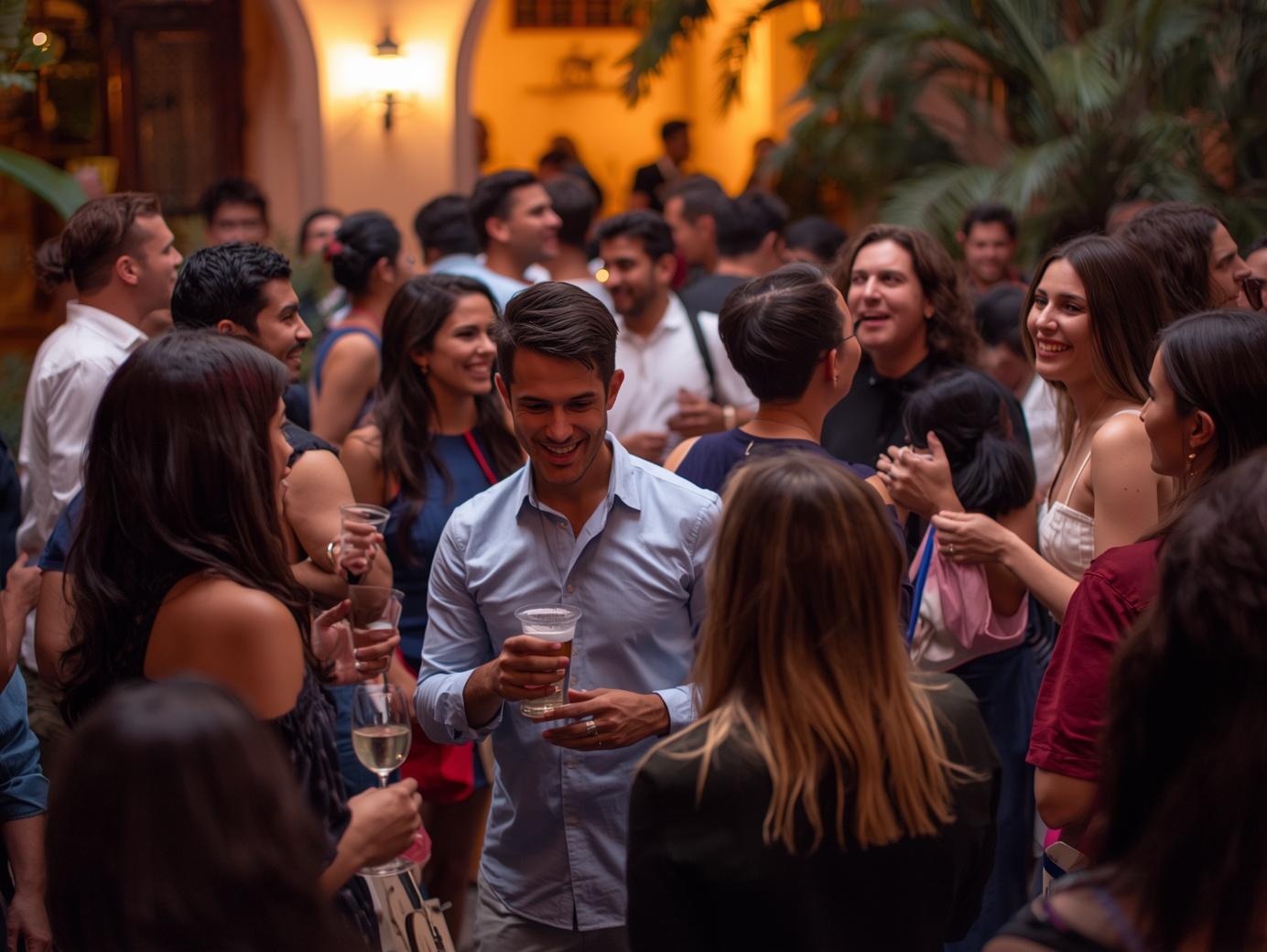
They almost never begin in explicitly expat-facing contexts. They begin in the mixed environments where the city’s different social worlds intersect: the dinner hosted by a local professional for a mixed group of friends, the cultural event that draws both international and local attendees, the neighborhood bar that has somehow resisted becoming purely a tourist destination and maintained its local character.
They tend to involve an early signal of genuine engagement with Mexico: a few words of Spanish deployed with genuine intention, a specific question about the neighborhood’s history, a demonstrated curiosity about the food or the art or the architecture that is not merely performative. These signals are read accurately and responded to with a warmth and openness that the purely surface-level engagement does not receive.
And they tend to develop slowly, through repeated encounter in shared social spaces, in the way that the best connections in any city develop: not through the efficiency of a curated introduction, but through the accumulation of shared experience in a place that both people have genuinely chosen to inhabit.
The City That Rewards Genuine Presence
The argument that runs through everything in this piece can be stated simply: Mexico City rewards genuine presence and punishes surface engagement. This is true of the city as a social and cultural experience. It is true of the city as a romantic destination. And it is a feature, not a bug, of a city that has been shaped by a culture that has always known the difference between a guest and a friend.
The conditions that produce the best romantic outcomes in Mexico City are not conditions of scarcity — the right people are there, in sufficient quantity and quality. They are conditions of quality of engagement: the willingness to show up fully, to invest genuinely, to participate in the city’s social world as someone who is there because they chose to be there, and who intends to stay long enough for the city to become theirs.
For the accomplished single who approaches it this way, Mexico City in 2026 offers something that is becoming increasingly rare in more established global cities: a social world that is genuinely in formation, populated by genuinely interesting people, situated in a culture that takes human connection seriously, and available to those who are willing to invest in it with the quality of attention it deserves.
—————————————————
Join the Amari Club Waitlist
Amari Club connects exceptional men with extraordinary partners.
Apply for early access to our private membership network.